Choose the effect first
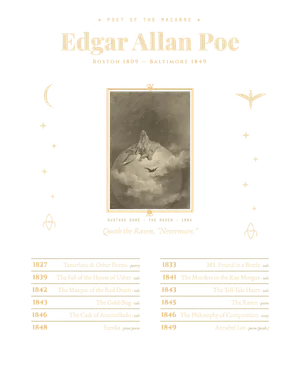
In The Philosophy of Composition, published in 1846, Poe describes a method built around the effect he wants to produce. The poem is planned backwards from the impression it should leave, with each detail serving the atmosphere rather than competing with it.
That account is also a piece of literary theatre. Poe is explaining his own work after the fact, so it should be read as a theory and a performance, not as a laboratory record of every line. The method remains revealing even with that limit in mind.
A refrain that becomes a voice
Poe chooses a short, sonorous and melancholy word: Nevermore. The raven repeats it without understanding the grief it awakens. At first, the young man asks a question almost playfully. Then he asks another because the same answer seems to conceal a meaning.
The word stays fixed while the situation darkens. Each return gives it a new weight, just as a refrain in a song can sound different after the verse has changed the listener. The final repetitions no longer feel like a bird’s lesson. They sound like the shape of the man’s own thoughts.
The poem as a night watch
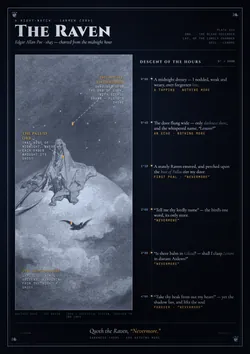
The power of The Raven is not only in the image of the bird. It comes from the controlled narrowing of possibilities. A door opens, a visitor arrives, a voice answers, and every question brings the speaker closer to what he cannot accept.
That is why the poem lends itself to a chart or a night watch. The hours pass, the questions descend and the single word becomes an instrument for measuring grief.