A physician enters the witch trials
Johann Weyer was a Dutch physician who published De praestigiis daemonum in 1563. His position was unusually direct for the period: witchcraft did not exist in the way courts claimed, and people accused of practising it should be treated rather than punished.
Weyer’s argument challenged the machinery around witch trials. The accusations might look supernatural, but the human consequences were entirely real. His medical language moved the question away from confession and punishment, towards illness, fear and care.
The appendix that became the headline
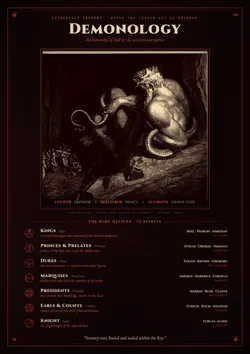
In 1577, a later edition included the Pseudomonarchia Daemonum, the “false monarchy of demons”. The appendix lists sixty-nine spirits with titles, powers and ranks. It borrows the architecture of a court: kings, princes, dukes, marquises and one knight.
That catalogue is the part that survived in the popular imagination. Its surrounding argument, which treated witchcraft as a delusion and a medical problem, became much easier to overlook. A text can preserve a strange inventory while losing the reason it was written.
From Weyer to the Goetia
The later Ars Goetia, the first section of The Lesser Key of Solomon, keeps much of Weyer’s structure and expands the list to seventy-two names. It also gives the spirits seals that are absent from Weyer’s catalogue. The result is the version most readers now recognise from modern occult imagery.
The visual language remains powerful because it looks orderly. Ranks, symbols and diagrams turn uncertainty into a system. The poster follows that tension: a neat hierarchy on the surface, and a forgotten medical protest underneath.