Gold is the shortcut people remember
Say “alchemy” and the philosopher’s stone usually arrives first: an impossible substance, a base metal, a flash of gold. It is a powerful image because it turns transformation into an instant result.
But the history behind the image is slower and more physical. Alchemists worked with furnaces, vessels, minerals, liquids and fumes. Their ideas were mixed with religious, philosophical and cosmological systems, but they also required close attention to material processes.
The stone is the promise. The table is where the work happens.
Zosimos described the apparatus
Around the year 300, Zosimos of Panopolis wrote about alchemical operations and the equipment used to carry them out. The Science History Institute notes his descriptions of apparatus for distillation, sublimation, filtration and fixation. His writing was organised around transmutation, but it was not a random hunt for treasure.
That detail changes the picture. An alchemical workshop was a place of repeated actions, observations and theories about why matter behaved as it did. Some instruments had roots in cookery, perfumery and craft. Ideas travelled with tools.
It would be wrong to say that alchemy simply invented modern chemistry. The two histories overlap at some moments and diverge at others. Still, the clean opposition between “mystical alchemy” and “serious chemistry” hides a much messier past.
The process is the story
The comparison with an image generated from a prompt is deliberately imperfect. It is there to expose a contemporary desire for transformation without visible labour. Alchemy tells a different story: the desired result is inseparable from the procedure imagined to reach it.
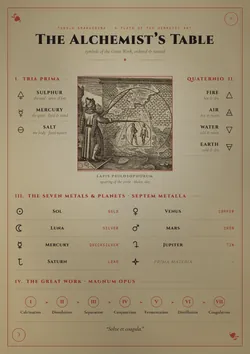
That is why alchemical symbols endure. They do not only stand for a final treasure. They turn heat, delay, dissolution and recombination into a visual grammar. Before the promise of gold, there is the difficult question: what must change, in what order, for a material to become something else?